Cardiology
Comprehensive Heart Care, Prevention, Treatment and Rehabilitation
Thank You For Visiting Bozeman Health Cardiology!
Taking care of your heart health can feel overwhelming, but you don’t have to do it alone. At Bozeman Health Cardiology, we’re here to support you every step of the way. Our comprehensive approach includes preventive care to catch issues early, advanced treatment options for effective, minimally invasive care, and personalized cardiac rehabilitation to aid your recovery and long-term health. For more complex procedures, we’ll coordinate the right care for you and provide the post-care support you need. With expert providers, cutting-edge technology, and compassionate care, we help you take control of your heart health with confidence.
Cardiology Team
Preston M. Schneider
MD, MSc, FACC
Cardiovascular Services
Cardiology
Sean Bell
MD, FACC
Cardiology
Alexander P Taylor
MD, FACC
Cardiology
Christopher Anzalone
DO, FACC
Cardiology
Sara Klinger
DO, FACC
Cardiology
Vincenzo Polsinelli
MD
Cardiology
Christine Laramee
PA-C
Cardiology, Non-invasive Cardiology
Erin Locke
DNP, FNP-BC
Cardiology
Katelyn Luter
RN
Cardiology
Mozelle M Soule
PA-C
Cardiology
Natalie Stasi
PA-C
Cardiology, Non-invasive Cardiology
Trish Dams
PA-C
Cardiology
Dane E Sobek
MD
Interventional Cardiology
Nathaniel J Madsen
MD
Interventional Cardiology
Jim Brown's Story
Taking the First Step Toward a Healthier Heart
Your heart health journey starts with you. Whether you’ve noticed symptoms like shortness of breath, chest discomfort, or simply want to stay proactive, your primary care provider can be your first guide in identifying potential heart concerns. Through routine check-ups and screenings, they can detect early signs of heart issues and connect you with our expert cardiology team for specialized care. No matter how you arrive, we’re here to provide the expert care you need to help you take control of your heart health with confidence.
Diagnostic Services
Echocardiogram
An Echocardiogram, or Echo, is a safe and painless test that uses sound waves to take pictures of your heart. It helps doctors check how well your heart is working by looking at its chambers, valves, and pressure. Echo tests are the most common way to look at the heart. At Bozeman Health, we use the latest ultrasound technology and special techniques to get clear, detailed images of your heart. Our lab is accredited, which means we meet high standards for quality in all types of echo tests, including ones done on the chest, through the throat, and during exercise
Stress Tests
Treadmill ECG
A stress test, also called a regular exercise test, checks how well your heart works when you’re active. During the test, you walk on a treadmill while doctors watch your heart’s electrical activity with an EKG machine. The test usually takes about 5-15 minutes to complete. It begins at a slow pace and gradually increases along with the incline of the treadmill. This test helps show if your heart is getting enough blood and can find signs of heart disease or the cause of symptoms like chest pain, shortness of breath, or upper back pain.
Stress Echocardiogram
A Stress Echocardiogram or Stress Echo, is a diagnostic test that combines an Echocardiogram with a treadmill exercise test to evaluate the heart’s function under physical stress. During the procedure, the patient exercises on a treadmill to increase heart rate, while ultrasound images of the heart are captured to assess its structure and function. This test helps detect heart conditions, including coronary artery disease and heart valve abnormalities, by observing how the heart responds to increased workload.
Nuclear Exercise Stress Test
Pharmacological Stress Test
This test uses a medication called Dobutamine to increase your heart rate. It assesses the heart’s function and structures. This test is usually used when you are unable to exercise.
Pacemaker
- A pacemaker is a small device that helps control your heartbeat. If your heart beats too slowly or unevenly, one of our interventional cardiologists can place a pacemaker in your chest to help it stay at a steady, healthy rhythm.
- During the procedure, the cardiologist makes a small cut, usually near the shoulder, and guides thin wires into the heart. These wires connect to the pacemaker, which sends tiny electrical signals to keep your heart beating normally. The procedure is safe, and most people can go home the same day or the next. A pacemaker can help you feel better and have more energy by keeping your heart working as it should.
Cardiac CT
Coronary CTA
Coronary Computed Tomography Angiography (CCTA) is a test that helps doctors see if there’s plaque in the blood vessels that supply the heart, called coronary arteries. Plaque is made up of fat, cholesterol, and calcium, and it can build up inside the arteries over time. This buildup can narrow the arteries and sometimes block blood flow. During a CCTA test, a special contrast material with iodine is injected into your vein to help the doctor see clear pictures of the heart’s blood vessels. The test uses a type of scan called a CT or CAT scan. It takes multiple pictures of the inside of your body, which can be turned into 3D images.
Don’t Wait for a Sign, Protect Your Heart Now
Cholesterol Management Clinic
Heart Failure Doesn’t Mean
Giving Up: Explore Effective
Treatment Options
Heart Failure Doesn’t Mean Giving Up:
Explore Effective
Treatment Options
Live Well With Heart Failure
Fit for Life
May appear to be a gym, but it offers so much more than local health clubs. Staffed by RNs and clinical exercise physiologists, Fit for Life creates individualized programs that are monitored by professionals with expertise not only in exercise but also in chronic disease prevention, such as heart disease, pulmonary disease, hypertension, vascular disease and diabetes.
Recovery and Rehabilitation
Cardiovascular Rehabilitation
A medically supervised education and exercise program for those diagnosed with particular heart conditions. The education portion provides you with vital information on the management of cardiovascular health and risk factor reduction. The exercise portion is tailored specifically to your individual needs and fitness level. Through supervised exercise, encouragement and support, Cardiovascular Rehabilitation can help you improve your overall level of physical conditioning, regain your confidence and strength, and provide you with the motivation and encouragement needed to make positive lifestyle choices. The Cardiac Rehabilitation program is certified through the American Association of Cardiovascular and Pulmonary Rehabilitation.
Respiratory Rehabilitation
Pacemaker & Implantable Device Clinic
A Pacemaker and Implantable Device Clinic a specialized clinic where patients with heart devices, like pacemakers or defibrillators, can go for check-ups, adjustments, and troubleshooting. The clinic is run by our skilled cardiology team who make sure your device is working properly and answer any questions you might have about their devices.
Regular visits to the clinic help ensure your device is keeping your heart in a healthy rhythm and improving overall heart health
Advanced Technology, Life-Saving Care: Precision Heart Treatments in Our Cath Lab
Cardiac Catheterization Laboratory
Cardiac Cath Lab
A Cardiac Catheterization Lab, or Cath Lab, is a special hospital unit where doctors diagnose and treat heart problems using thin, flexible tubes called catheters. These procedures help check for blocked arteries, heart valve issues, and other heart conditions without the need for major surgery. In the Cath Lab, doctors can perform tests like angiograms to see how well blood is flowing to the heart and treatments like angioplasty and stent placement to open blocked arteries. They also use advanced techniques to treat heart rhythm problems and other conditions. The goal of the Cath Lab is to quickly and safely improve heart health, often allowing patients to go home the same day.
Services Offered
Cardiac Catheterization (also called Cardiac Cath) is an invasive imaging procedure that allows your healthcare provider to evaluate your heart function. Your provider puts a catheter (tiny tube) into a blood vessel in your arm or groin and then into your coronary arteries. Providers can use heart catheterization to find problems and use other procedures to fix them, sometimes during the same appointment.
For example, your provider could fix a heart flaw you were born with or replace your heart valve without making a large incision and doing traditional surgery.
In a right heart cath, your healthcare provider guides a small, hollow tube called a pulmonary artery (PA) catheter to the right side of your heart. They then pass the tube into your pulmonary artery.
This is the main artery that carries blood to your lungs. Your healthcare provider observes blood flow through your heart and measures the pressures inside your heart and lungs.
- A pacemaker is a small device that helps control your heartbeat. If your heart beats too slowly or unevenly, one of our interventional cardiologists can place a pacemaker in your chest to help it stay at a steady, healthy rhythm
- During the procedure, the cardiologist makes a small cut, usually near the shoulder, and guides thin wires into the heart. These wires connect to the pacemaker, which sends tiny electrical signals to keep your heart beating normally. The procedure is safe, and most people can go home the same day or the next. A pacemaker can help you feel better and have more energy by keeping your heart working as it should.
A Transesophageal Echocardiogram (TEE) is a special test that helps our cardiologists see how the heart is working. It uses sound waves, kind of like an ultrasound, to create pictures of the heart. A small device called a transducer sends out sound waves that bounce off the heart and create images on a computer screen. Most heart ultrasounds, called transthoracic echocardiograms, are done by placing the transducer on the chest.
But with a TEE, the doctor gently guides a thin, flexible tube with a transducer down the esophagus (the tube that carries food to the stomach). Since the esophagus is right next to the heart, this method gives clearer pictures because the sound waves don’t have to go through the skin, muscles, or bones. This helps doctors get a better look at the heart’s structure and function.
Cardioversion is a treatment that helps fix an uneven heartbeat. It uses quick, low-energy electrical shocks to get the heart back to a normal rhythm.
This is often used for people with irregular heartbeats, like atrial fibrillation (AFib). In some cases, doctors can also use medicine instead of electrical shocks to correct the heartbeat.
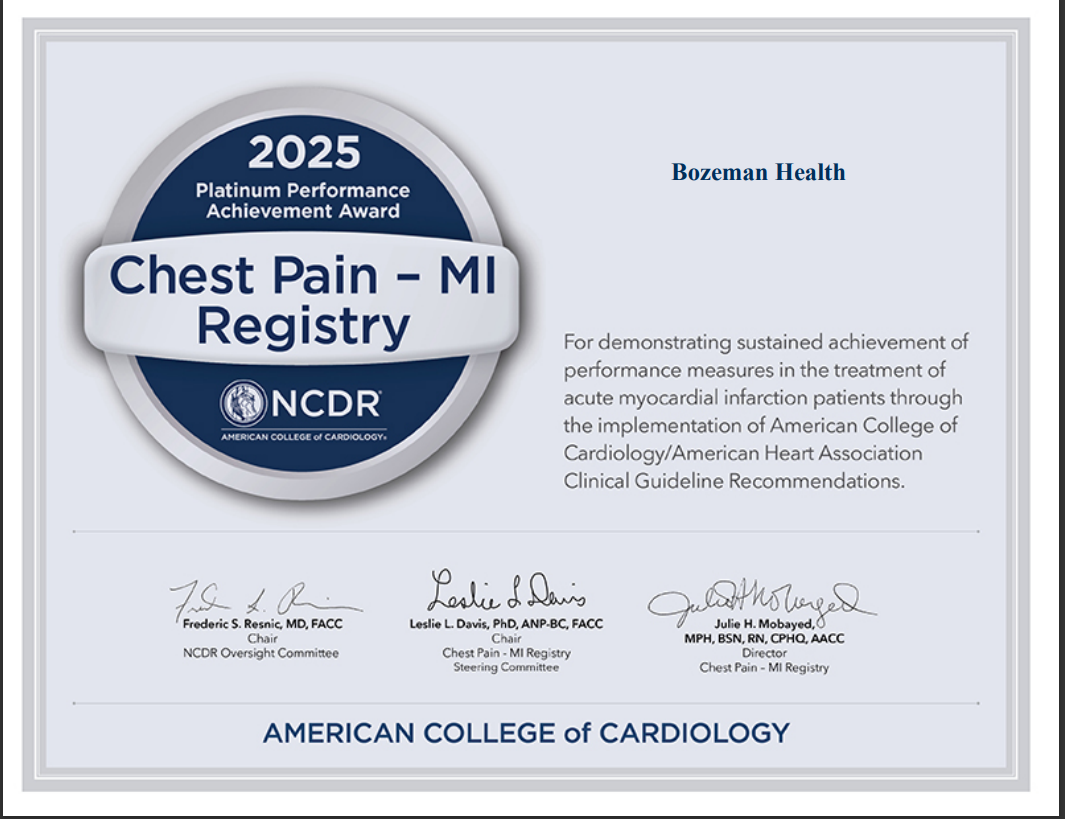
Bozeman Health Recognized by The American Heart Association
Bozeman Health Earns National Quality Award for Heart Attack Care
Anatomy of the Heart
Understanding the anatomy of the heart can help you have better conversations with your cardiologist and take an active role in your care. Knowing basic terms like arteries, valves, and chambers makes it easier to understand your condition, test results, and treatment options.
It also helps you ask informed questions and follow your doctor’s advice more confidently. The more you understand your heart, the better you can work with your cardiologist to keep it healthy.
Anatomy of The Heart
Your heart is the engine that drives your body. Without it, blood couldn’t circulate and your organs wouldn’t get the oxygen and nutrients they need to work properly. The heart is found behind the rib cage in the center of the chest between the lungs. A normal and healthy adult heart is about the size of a fist.
Learn more about the structures that make the heart’s continuous pumping cycle possible.
Coronary Arteries
Superior Vena Cava
This large vein is the passageway for deoxygenated (oxygen-poor) blood returning to the heart from the head, chest and arms. The superior vena cava empties into the heart’s upper-right chamber, the right atrium.
Inferior Vena Cava
Right Atrium
Right Ventricle
Pulmonary Artery
Left Atrium
Left Ventricle
Aorta
Septum
Pericardium
Myocardium
Endocardium
Sinoatrial Node
Nestled in the wall of the right atrium, this bundle of tissue sends out precisely timed electrical signals that set the heart’s pace. These signals travel through each of the heart’s chambers, causing each to contract in carefully timed succession. The contractions squeeze blood along its path through the heart’s valves and chambers.
You can think of the sinoatrial node as the heart’s pacemaker.